I sometimes feel like the last generation of handwriters. I mean, obviously kids are still using it in school, but they don't seem to prefer it. If they could do everything digital, they would. And in all fairness, I would really describe myself as a half-breed. I grew up with a computer at home and in the classroom (but before Google). I am incredibly well-versed in computer use and do usually prefer it, but not always.
I don't prefer handwriting. It takes a long time to get thoughts out, makes my arm and wrist sore after a while, and takes up a lot more space to keep it all (not to mention paper seems a lot more brittle). On a computer, I can store everything I've ever created, put down my thoughts about as fast as I can come up with them (sometimes faster), and can go a lot longer before I feel physically weary. Also, editing is a heck of a lot easier.
However, paper does have its own unique benefits. The physical act of writing letters makes me remember things better. It helps me come up with ideas in a seemingly different way. I can sometimes find information faster flipping through pages than doing a search function (because I know where on a page I wrote something).
The point of this post, though, is not Paper vs. Digital. The point is that the value is in paper and digital. I like to take a notebook and get some writing down, but it doesn't stay on paper exclusively. Eventually, I have to type it up. And this actually leads to an experience unique to the combination of these forms.
Paper is where I write my rough draft, but when I type it into my computer, I edit as I do so. It's not major editing, usually. Mostly, if a line doesn't read smoothly, I revise it. And if some scene feels lacking or needs explanation (or if during the rough draft, I have a note to add a new scene), I can add it in during this time. By the end, I have a draft that has already had its first revision and is cleaner than the original.
If I hadn't written the paper version first, then my rough draft would be the first things that came to mind. Admittedly, I would be revising that draft several times anyway, but the beauty is that in order to have the draft ready to show to others, I have to revise it at least once. And I really like that about this system, especially since I find that I revise differently when reading from paper than from a screen.
This kind of ties in with an earlier post in that, "If you know how your mind works, you can take advantage of it." The mind just processes handwriting and typing differently. It processes paper and screens differently. Too many people argue about paper and digital as though they are in competition. They aren't. They do different things. And if you can learn and understand what they do for you, then you can take advantage of both of them.
Friday, December 7, 2012


Thursday, December 6, 2012
Vestigial Words
I enjoy the rich history of English, and vast lexicon that it has from the wide range of languages it's borrowed from and the hundreds of years it has had to grow and evolve. But with evolution, we retain traces of our origins. In fact, we have vestigial words, much the same that we have vestigial structures in our own bodies. There are some words that only exist in old phrases that we have retained, even though the word is long dead. The funny thing (and by funny, I mean really annoying) is that most people don't know about the history of the word, so when they use the phrase, they often use it wrong.
For example, we have the phrase "champing at the bit". I don't know if I've ever heard somebody actually say the phrase correctly. Everybody says "chomping". It makes sense to some degree, since that's actually a word in use. In fact, champing and chomping are nearly the same thing. The problem is that chomping at the bit isn't a phrase. (Hell, even fewer people know what the phrase literally means.)
Another vestigial word is "jack". Yes, it's a word spoken almost every day, and it's usually used correctly, but not in the phrase "jack-of-all-trades". Notice that "jack" is not capitalized. That's because it's not a name; it's a title (or at least a description). Think about a deck of cards - the third face card is the jack, not Jack. Although we usually use the phrase correctly, we live in the age of political correctness, so some dumbass decided that a woman who knows a little bit about a lot of things is a Jane-of-all-trades, and now we have a problem.
I think vestigial words are pretty interesting, mostly in that they are a link to the past. I also find it curious that a word can fall out of usage, but a phrase that uses it will remain. I don't usually mind their use, either. But if you find a word or phrase where "I don't know how to define it, but I know how to use it in a sentence", then look it up. You can find out more about your language and it will mean more to you when reading and writing it.
For example, we have the phrase "champing at the bit". I don't know if I've ever heard somebody actually say the phrase correctly. Everybody says "chomping". It makes sense to some degree, since that's actually a word in use. In fact, champing and chomping are nearly the same thing. The problem is that chomping at the bit isn't a phrase. (Hell, even fewer people know what the phrase literally means.)
Another vestigial word is "jack". Yes, it's a word spoken almost every day, and it's usually used correctly, but not in the phrase "jack-of-all-trades". Notice that "jack" is not capitalized. That's because it's not a name; it's a title (or at least a description). Think about a deck of cards - the third face card is the jack, not Jack. Although we usually use the phrase correctly, we live in the age of political correctness, so some dumbass decided that a woman who knows a little bit about a lot of things is a Jane-of-all-trades, and now we have a problem.
I think vestigial words are pretty interesting, mostly in that they are a link to the past. I also find it curious that a word can fall out of usage, but a phrase that uses it will remain. I don't usually mind their use, either. But if you find a word or phrase where "I don't know how to define it, but I know how to use it in a sentence", then look it up. You can find out more about your language and it will mean more to you when reading and writing it.
Wednesday, December 5, 2012
Make Small, Satisfying Bits
I was talking with a friend and lamenting about how not fun the creative process can be. We basically came to the conclusion that the most annoying part of the process is when we are having to put forth effort. I know it's laughably stupid, but it has a certain logic.
What's actually satisfying? For me, it's having a finished product I can be proud of. It's having something work right. It's even building the mechanism, knowing how it will work when completed.
What's aggravating? Building that plan, especially from scratch.Trying to scrape together randomly floating ideas and make them concrete, weave them to work with each other, and to do so seamlessly. That is a tremendous amount of work, and more often than not, when you finally do figure out the basic plan, you spend just as much time patching holes or ripping out pieces and making new ones.
So from there, the conclusion is that the best part of a creative task is having the finished product, and building it from a solid plan.
But this is where you ask yourself what a finished product is. Most people would say, "well, duh, it's the book." And, they would be right. But you could also say it's the outline. Or it's the chapter. Or the paragraph. Or the elevator pitch. Or the closing line. Or the opening scene. Or creating the pivotal twist. And all of those would be right.
If you know how your mind works, you can take advantage of it. I break down projects into small, satisfying bits. I can't honestly believe that writing one word is real progress, but if I wrote a good chapter, or even a good page, it's progress I can be proud of. It's enough to keep me heartened and wanting to do more. If I can keep reaching the next checkpoint, it doesn't matter if there's a thousand of them, I'll reach the finish line.
What's actually satisfying? For me, it's having a finished product I can be proud of. It's having something work right. It's even building the mechanism, knowing how it will work when completed.
What's aggravating? Building that plan, especially from scratch.Trying to scrape together randomly floating ideas and make them concrete, weave them to work with each other, and to do so seamlessly. That is a tremendous amount of work, and more often than not, when you finally do figure out the basic plan, you spend just as much time patching holes or ripping out pieces and making new ones.
So from there, the conclusion is that the best part of a creative task is having the finished product, and building it from a solid plan.
But this is where you ask yourself what a finished product is. Most people would say, "well, duh, it's the book." And, they would be right. But you could also say it's the outline. Or it's the chapter. Or the paragraph. Or the elevator pitch. Or the closing line. Or the opening scene. Or creating the pivotal twist. And all of those would be right.
If you know how your mind works, you can take advantage of it. I break down projects into small, satisfying bits. I can't honestly believe that writing one word is real progress, but if I wrote a good chapter, or even a good page, it's progress I can be proud of. It's enough to keep me heartened and wanting to do more. If I can keep reaching the next checkpoint, it doesn't matter if there's a thousand of them, I'll reach the finish line.
Tuesday, December 4, 2012
The Middle Of The Spectrum
The stories we tell are about amazing things that happened. Some of them are fantastic and some of them are miserable, but they're always exciting enough to want to share. But not every experience is at one end of the spectrum. It's possible to have an experience that was bad, but not a trainwreck.
In one sense, the worst story is the one that's tame. Never having anything interesting happen makes it a long series of events that have no meaning.
In another sense, these stories can demonstrate a certain despair in life. They play off of our expectations of adventure, and show us how plain life ends up being. Of course, that only works when you're doing it on purpose (or by extreme luck), but the point stands that stories in the middle of the spectrum are not always useless. They just tend to have fewer uses.
That's probably why I like those stories, though. They don't have many uses, which often makes them underused, and yet they still can hold power, which makes me want to tell them.
In one sense, the worst story is the one that's tame. Never having anything interesting happen makes it a long series of events that have no meaning.
In another sense, these stories can demonstrate a certain despair in life. They play off of our expectations of adventure, and show us how plain life ends up being. Of course, that only works when you're doing it on purpose (or by extreme luck), but the point stands that stories in the middle of the spectrum are not always useless. They just tend to have fewer uses.
That's probably why I like those stories, though. They don't have many uses, which often makes them underused, and yet they still can hold power, which makes me want to tell them.
Monday, December 3, 2012
Spend An Hour A Day
I will always remind people that "you are only a writer on days you write." What I don't always mention is that you don't have to spend all day doing it. You are still a writer if you spend an hour a day writing.
In fact, I give this advice to anybody that really wants to do something. It could be drawing, photography, astronomy, differential equations, knitting - anything. Spend an hour a day working on it. I prefer doing it an hour before going to sleep. Some people prefer doing it the first hour after waking up. Whatever time during the day you choose, section off one hour and just go for it.
The other part of that to remember is that projects usually require work in many parts. Being a writer is more than just putting words on paper. We have to come up with an idea. We have to make our characters, our settings, research facts we don't know but need, and we have to plan out where things will be going (and also acknowledge that they may go elsewhere, but that a starting point is important).
The hour a day you spend writing may not have much in the way of words put down, but it will have effort invested (which admittedly may fly in the face of "only on days that you write"). Thinking about things, exploring ideas, building layers, sketching out scenes, all of these count, even if you aren't always adding to your draft, you're doing work.
An hour a day adds up a lot faster than you think. You'll be amazed at what you can do by putting in that effort.
In fact, I give this advice to anybody that really wants to do something. It could be drawing, photography, astronomy, differential equations, knitting - anything. Spend an hour a day working on it. I prefer doing it an hour before going to sleep. Some people prefer doing it the first hour after waking up. Whatever time during the day you choose, section off one hour and just go for it.
The other part of that to remember is that projects usually require work in many parts. Being a writer is more than just putting words on paper. We have to come up with an idea. We have to make our characters, our settings, research facts we don't know but need, and we have to plan out where things will be going (and also acknowledge that they may go elsewhere, but that a starting point is important).
The hour a day you spend writing may not have much in the way of words put down, but it will have effort invested (which admittedly may fly in the face of "only on days that you write"). Thinking about things, exploring ideas, building layers, sketching out scenes, all of these count, even if you aren't always adding to your draft, you're doing work.
An hour a day adds up a lot faster than you think. You'll be amazed at what you can do by putting in that effort.
Sunday, December 2, 2012
Change The Spectators' Minds
I've been arguing with people on the internet since the 90s. Sadly, this doesn't make me an old man. It means that I was a petulant brat back when I started. I was picking fights with trolls and idiots, probably acting like both of them more often than not.
Through my teens, I was fighting to win. I really thought I could argue somebody into submission. If I could refute every claim a person made, they would eventually run out and realize they were wrong. I can count on one hand the number of times that worked.
As I grew older, I calmed down. Arguing with strangers became boring (and aggravating and depressing). It was an exercise in futility. There was a constant stream of new people saying the same dumb things, and there I was making the same arguments day after day, seeing no change.
I stopped arguing with people because the reality eventually hit me that I can't change the minds of the willfully ignorant. People who will ignore facts in order to maintain their position are completely incorrigible.
I didn't drop out of the internet, nor did I leave the message boards I hung out in. I just stopped posting so much, choosing instead to read. During this time, I saw that discussion continued on, arguments still took place, and plenty of others were ready to take up the mantle on either side.
What was interesting was that during this time, I found many arguments affecting my thoughts. People on sides I would normally oppose had interesting things to say and they made me question some of my long-held beliefs. And there was the revelation.
The internet is a public forum. There are people talking, other people talking back, and countless more only listening. People arguing with each other may not change their opponents' minds, but they can greatly influence the onlookers.
We all have beliefs. Some of them are very precious to us. If we truly believe them, then we must be willing to defend them and to educate people who would denounce those beliefs. Argue with them, and do it in a public forum, whether it be a live debate or a stream of letters to the editor in a newspaper, and do it because you know that other people are listening. They are undecided people, or at least those who could be convinced opposite of their leanings. They are the people you must reach before somebody else reaches them first.
Through my teens, I was fighting to win. I really thought I could argue somebody into submission. If I could refute every claim a person made, they would eventually run out and realize they were wrong. I can count on one hand the number of times that worked.
As I grew older, I calmed down. Arguing with strangers became boring (and aggravating and depressing). It was an exercise in futility. There was a constant stream of new people saying the same dumb things, and there I was making the same arguments day after day, seeing no change.
I stopped arguing with people because the reality eventually hit me that I can't change the minds of the willfully ignorant. People who will ignore facts in order to maintain their position are completely incorrigible.
I didn't drop out of the internet, nor did I leave the message boards I hung out in. I just stopped posting so much, choosing instead to read. During this time, I saw that discussion continued on, arguments still took place, and plenty of others were ready to take up the mantle on either side.
What was interesting was that during this time, I found many arguments affecting my thoughts. People on sides I would normally oppose had interesting things to say and they made me question some of my long-held beliefs. And there was the revelation.
The internet is a public forum. There are people talking, other people talking back, and countless more only listening. People arguing with each other may not change their opponents' minds, but they can greatly influence the onlookers.
We all have beliefs. Some of them are very precious to us. If we truly believe them, then we must be willing to defend them and to educate people who would denounce those beliefs. Argue with them, and do it in a public forum, whether it be a live debate or a stream of letters to the editor in a newspaper, and do it because you know that other people are listening. They are undecided people, or at least those who could be convinced opposite of their leanings. They are the people you must reach before somebody else reaches them first.
Saturday, December 1, 2012
Be Responsible For Knowledge
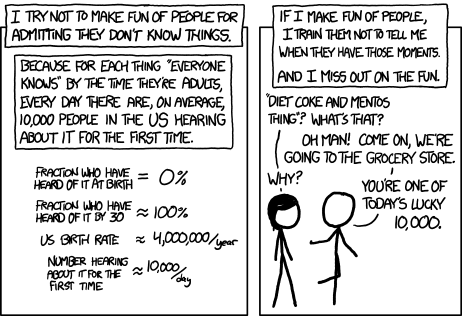
I saw recently a person remarking that he had only just learned that Alaska was not an island. The general response to that was "I don't want to live on this planet anymore", as though they were so ashamed of this person's ignorance that they didn't want to even be part of humanity anymore.
I hate those people. They are worse to me than the ignorant; they're elitist. Note that they aren't elite. They just think they are.
Face facts - nobody is born knowing everything. People are born knowing basically nothing. Knowledge takes a long time to acquire, and is even harder to gain when surrounded by misinformation (like basically every photo with a sentimental caption that gets spread on Facebook) and people who think the stuff they know is obvious or self-evident.
Look at a map. Alaska is always detached and placed off the coast of California. If every map you ever see shows Alaska like that, it would be perfectly sensible to think it was an island. The truly deplorable thing is that this person was not properly educated sooner. But that does not make him the problem; it makes him the victim.
If you have a problem with the level of intelligence in the world, then be responsible for knowledge. Go out there and educate people. You don't have to have a classroom or make it your career. You just need to spread truth and facts whenever you can and wherever you go.
As writers, you do not have to write textbooks. Any story can be educational. This is why you do research. Rather than making guesses or assumptions about a given subject, look up the facts. Not only do you make a more convincing story by being accurate, you also make every person who reads it a little smarter, for having acquired more knowledge (or reinforcing facts they had heard before).
Be like Randall Munroe of xkcd:

I hate those people. They are worse to me than the ignorant; they're elitist. Note that they aren't elite. They just think they are.
Face facts - nobody is born knowing everything. People are born knowing basically nothing. Knowledge takes a long time to acquire, and is even harder to gain when surrounded by misinformation (like basically every photo with a sentimental caption that gets spread on Facebook) and people who think the stuff they know is obvious or self-evident.
Look at a map. Alaska is always detached and placed off the coast of California. If every map you ever see shows Alaska like that, it would be perfectly sensible to think it was an island. The truly deplorable thing is that this person was not properly educated sooner. But that does not make him the problem; it makes him the victim.
If you have a problem with the level of intelligence in the world, then be responsible for knowledge. Go out there and educate people. You don't have to have a classroom or make it your career. You just need to spread truth and facts whenever you can and wherever you go.
As writers, you do not have to write textbooks. Any story can be educational. This is why you do research. Rather than making guesses or assumptions about a given subject, look up the facts. Not only do you make a more convincing story by being accurate, you also make every person who reads it a little smarter, for having acquired more knowledge (or reinforcing facts they had heard before).
Be like Randall Munroe of xkcd:
Subscribe to:
Posts (Atom)
